A waistband failure is the most visible defect in men’s underwear and the least expensive to prevent. Roll-over, loss of recovery and a band that leaves a mark are not usually elastic quality problems; they are construction problems, created by the way the elastic is specified, attached and finished against a particular body panel. By the time a buyer sees the failure in a returned garment, the cause is two stages back in the development process.
This guide looks at underwear waistband construction from the engineering side: what each construction type does, how the attachment method changes behaviour, and which measurements belong in the specification before sampling.
Which Construction Detail Drives the Fit
The waistband is a small piece of engineering with three variables: elastic type, attachment method and the tension the band is applied at. Elastic type sets the stretch range and the hand; the attachment method sets how that stretch is transferred to the body panel; and the applied tension decides how the band sits on a range of waist sizes when the garment is worn.
Comfort failures map back to those three variables rather than to the fibre of the body fabric. A band that rolls is usually applied under too little tension or attached with a single needle without a stabilising stitch. A band that marks the skin is normally applied above the recovery range the elastic was designed for. A band that relaxes after ten washes usually has an elastane content or a finishing route that does not survive the buyer’s wash cycle.
The wider range of options is set out in the underwear waistband options guide on elastics, fold-overs and silicone grips. This article takes the next step and treats the band as a structure with a measurable specification.
How the Options Differ on the Line
Four constructions cover most underwear programmes: a woven or jacquard elastic stitched to the body, a knitted elastic with a softer hand, a fold-over band made from the body fabric itself, and an exposed elastic with a bonded or ultrasonic finish. Each one changes the sewing operation, the pressing step and the inspection point.
| Construction | Typical use | Line implications |
|---|---|---|
| Woven or jacquard elastic, stitched | Branded waistbands, boxer briefs, trunks | Logo repeat must be centred on the front; stitch density and needle type control roll-over |
| Knitted elastic, stitched | Soft-touch briefs and premium basics | Softer hand; requires careful tension control to avoid wave at the waist |
| Fold-over self-fabric band | Seamless and minimal-seam styles | No separate elastic; recovery depends on fabric elastane and band width |
| Exposed elastic with bonded finish | Sport-led and compression styles | Reduces bulk and stitch marks; needs stable fabric and controlled bonding parameters |

The choosing factors are the band width relative to the garment size, the elastic stretch range measured against the size curve, and whether the brand needs a jacquard logo. A narrow band on a large size carries more load per centimetre, which raises the risk of marking; a wide band on a small size can buckle when the garment is pulled on.
Pattern and Grading Consequences
The waistband is one of the few components that should not be graded linearly with the body. If the elastic is cut to a percentage of the waist measurement, every graded size inherits the same proportional tension, which keeps the fit consistent across the size curve. If it is cut to a fixed length per size, larger sizes tend to carry too much tension and smaller sizes too little.
Band width is a second grading decision. Keeping the width constant keeps the visual proportion stable across sizes, while increasing the width slightly at the top of the range spreads the load on larger sizes. Either approach can work, but the rule has to be stated in the tech pack, because a factory that guesses produces a range that fits differently at each end of the size curve.
Grading also interacts with the rise. A high-rise brief places the band above the hip bone and needs less tension to stay in place; a low-rise trunk sits closer to the hip and relies more on elastic recovery. The same elastic specification can therefore suit a high rise and fail on a low rise, which is why rise and waistband specification should be reviewed together during sample approval.
Seam, Binding and Finishing Choices
How the band is attached matters as much as what it is made of. A double-needle stitched band is the most common and the most repairable; a bonded band reduces bulk and stitch marks but demands consistent fabric surface and controlled process parameters. Where the band meets the front panel, the seam position affects how the garment behaves when it is pulled on, and a small amount of stretch allowance at the front reduces strain on the band over the life of the garment.
Finishing also governs wash behaviour. Heat-setting and pressing influence how the band and the body recover after laundering, and the wash cycle the buyer specifies should be applied during development, not left for a bulk test. Where the garment contacts skin directly for long periods, restricted substance compliance for the elastic and its dye should be confirmed with an OEKO-TEX Standard 100 certificate for the finished article, alongside the general care labelling rules the buyer’s market applies.
Trims should be reviewed as a set rather than one by one. Thread, elastic, print and label all sit inside the same garment, and a change to any one of them can alter how the band reads on the finished product even when the elastic specification is unchanged.
Fit Testing Before Bulk
Waistband fit cannot be judged on a table. The garment has to be worn, washed and re-worn, because elastic behaviour changes through the first cycles. A practical development protocol measures the relaxed band length, the extended length at a set load, and the recovery after a short rest period, then repeats the measurement after the agreed wash cycle.
Stretch and recovery should be measured with a named method so the figure means the same thing to every party. Knitted fabric stretch, growth and recovery is commonly quoted against ASTM D2594, and stretch in elastic fabrics under ASTM D3107. Laundering and colourfastness test series are published by AATCC, and dimensional change and appearance after washing can be assessed by an independent institute such as Hohenstein.
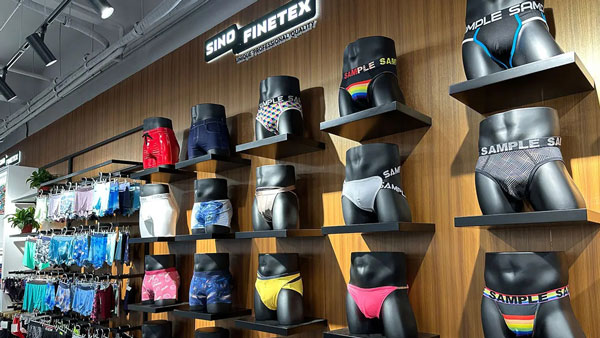
Fit panels are the lowest-cost way to test a size curve before bulk. A small run of fit samples in the top, middle and bottom sizes of the range shows how the band behaves across the curve, and it costs a fraction of a bulk commitment at approximately 20 to 50 pieces per style and colour.
A development panel of this kind also gives the buying team a baseline for the first bulk delivery. When band length, extension and recovery are recorded on the approved sample and repeated on the bulk lot, any drift shows up as a number rather than an opinion, which is what makes a second order repeatable without re-running the full approval process.
Quality Points to Inspect
Inspection should treat the waistband as a defined set of checkpoints rather than as part of the general garment. The points that catch the majority of failures are stitch density and needle damage, band alignment against the centre front, elastic width consistency, recovery after the wash cycle, and the absence of waviness at the seam where the band joins the panel.
A hand feel and tension check on a sample of garments from each bundle catches drift early, and a recovery check after washing catches the failures that only appear in use. Where the brand needs an independent judgement, third-party inspection against an agreed AQL plan from a body such as QIMA gives the buying team documented evidence at the stage where a claim can still be acted on.
Recording the results per lot, not per order, builds the history that makes the next order predictable. A waistband that passes at lot one and drifts at lot three usually shows up in the stitch density or the recovery figure long before it reaches the consumer.
Underwear Waistband Construction: Points to Lock Before Sampling
The specification should be complete enough that a factory can produce the band without further questions. The following points cover the variables that cause most rework in this component.
- Elastic type, composition and width in mm, with the stretch range and recovery target stated.
- Attachment method, stitch type and stitch density per centimetre, or the bonding method where applicable.
- Tension or applied extension at attachment, expressed as a percentage of the relaxed band length.
- Logo repeat and placement, with the centring tolerance for jacquard or printed branding.
- Recovery and dimensional change limits after the buyer’s wash cycle, with the test method named.
- Restricted substance requirement for the elastic and its dye, for the market the garment ships to.
- Inspection points and the AQL plan, agreed before bulk rather than at final inspection.
Two of those lines are usually missing from the first tech pack: the applied extension percentage, and the wash cycle used for the recovery limit. Supplying both removes the ambiguity that otherwise shows up as roll-over in bulk, after the elastic has already been purchased.
Conclusion
A comfortable waistband is the product of three controlled variables rather than a single good elastic. Elastic type sets the stretch range, the attachment method transfers that stretch into the garment, and the applied extension decides how the band behaves across the size curve. Grading rules, finishing and the wash cycle then decide whether the garment still performs after ten cycles.
The working sequence is to fix the construction and the applied extension, specify recovery and dimensional change with named test methods, verify the grade rule across the size curve, and inspect the band as a defined set of checkpoints. Sino Finetex develops waistband construction alongside the garment on the same men’s underwear line, and the capabilities page sets out the cutting, sewing and finishing scope behind it.
Review your waistband specification
Send the elastic type, width and target recovery you are working to, and we will confirm the construction, applied extension and inspection plan that suits your size curve.
Contact Sino Finetex for a specification review or a fit-sample plan.
FAQ
Why do underwear waistbands roll over?
Roll-over is usually an applied-tension problem rather than an elastic fault. If the band is attached under too little extension, the fabric above it folds over in wear; if the stitch type does not stabilise the band, the fold repeats along the waist. Check the applied extension percentage, the stitch density and the needle type first, then confirm the elastic’s own recovery against the wash cycle the garment will actually receive.
Should the waistband be graded with the body or cut separately?
Grade it proportionally against the waist measurement so every size inherits the same percentage of extension, and state that rule in the tech pack. Band width can stay constant or widen slightly at the top of the size range, but the choice has to be explicit. A band cut to a fixed length per size usually carries too much tension on large sizes and too little on small ones.
How should waistband recovery be measured before bulk?
Measure the relaxed band length, the extended length at a stated load, and the recovery after a rest period, then repeat after the buyer’s wash cycle. Name the test method so the figure means the same thing to every party; ASTM D2594 and ASTM D3107 are commonly used for knitted and elastic fabric behaviour. Keep the results per lot so drift shows up before it reaches the consumer.
Does waistband construction change the minimum order quantity?
It changes the development cost rather than the quantity tier directly. A new elastic construction, a jacquard logo or a bonded finish needs its own sampling round, which is available at the quick-response tier of approximately 20 to 50 pieces per style and colour. Once the construction is approved, bulk quantities follow the fabric route: approximately 1,000 pieces per colour from stock fabric and approximately 3,000 pieces per colour for custom fabric or printed work.
Explore the related decisions in the Underwear Fit and Construction.