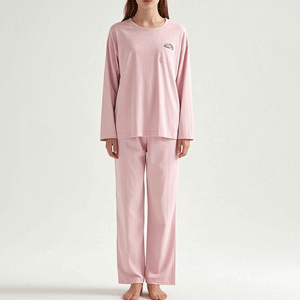

Diagnose button-front pajama placket gaping by checking where the opening appears in different postures before changing the pattern or adding a button.
Last updated:
How do you diagnose button-front pajama placket gaping?
To diagnose button-front pajama placket gaping, mark where the layers separate while standing, sitting, and turning onto the side. Compare the same points with the shirt relaxed on a table. Check the overlap, button placement, and pull lines before deciding whether to revise the closure or give the wearer more room.
The placket is the front opening and its supporting layers. The CJGD pajama catalog includes button-front styles. The catalog silhouette helps identify a design route. The opening has to be tested on the finished sample with its actual buttons, buttonholes and material.
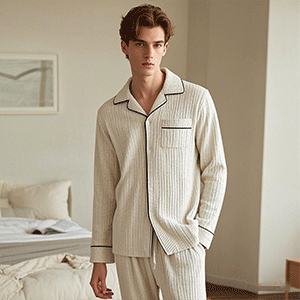
Mark coverage between the buttons as well as at each button
Look at the front and seated pajama photos from our catalog. The first shows the opening along the top and the second illustrates a change in posture. Use those views to decide where your fitting photos should be taken. On the actual sample, measure the overlap where the two front edges meet, and check how much the underlap still covers between buttons. Write down whether the request applies across the entire opening or at a particular zone.
Lay the top flat with the closures engaged. Check whether the button centers meet the intended buttonhole positions, the edge is straight, and the fronts have the expected lengths. That records the construction before you introduce body tension. Oliver + S’s pajama pattern notes provide an example of how a button-front pajama is developed as its own pattern. Our sleepwear construction guide also discusses grading the opening and button spacing.
What changes if the opening only gaps in one posture?
Check the fit from the front while standing. Have the wearer sit normally and fold or reach their arms as they would while lounging. Then check which area presses or pulls when lying on the side if that is part of the intended use. Take photos with the same garment fully closed and mark whether the placket opens between buttons, pulls diagonally from another part of the top, or twists along its edge.
| What you see | Check in the next trial | Keep constant |
|---|---|---|
| Gap already present on the flat sample | Button position, buttonholes, overlap, or a twisted facing | Pattern revision and measurement points |
| Gap at the chest only when seated or reaching | Body and arm ease, along with the position of the nearest closure | Same wearer, sample size and pose |
| Gap recurs farther down when the top rides up on the hip | Room at the lower opening and the amount of overlap there | The intended length and wearing position |
An extra button may help hold a local gap together when the shirt already has room to move. When the fabric is visibly pulling from another area, ask the pattern maker to assess the underlying fit. The pajama size and fit guide provides context for checking the rest of the garment.

Check the revised front again after the intended care
Repeat the flat and worn checks on the revised sample before sealing it. If the opening has changed since the wash or dry trial, compare front length, visible overlap, and the shape of the facing. AATCC’s garment dimensional-change method addresses length and width after home laundering. Inspect the gap and coverage separately on a wearer.
Keep a close photo of the original failure, a marked pattern or closure drawing, and an image of the correction in the same posture. Ask the pajama development team whether the approved change affects adjacent graded sizes.
Decide which measurements to carry into the next size
Keep the position of the worst opening and the fit posture in the sample report. If a wider overlap solved the problem without changing body fit, review that overlap on the affected adjacent size before changing the whole grade. If the problem came from a tight front across the chest, compare the new pattern and fit notes along with the button positions. Record both the flat dimensions and what the closure looks like in use. That gives the next fitter a way to recognize the same failure even when the fabric color changes.
Questions about button-front pajama fitting
Should the button gap be checked only while standing?
Include the positions the customer will use. The finished-fit question is separate from the construction seen in the Oliver + S pattern example.
Can a button-front style have different closure spacing in different sizes?
Record the approved positions and check the smallest and largest affected sizes if the grade changes the front length. The CJGD catalog offers examples of different styles, which should each use their own closure specification.
When should the team compare the post-wash sample?
Review it before bulk release under the intended care conditions. AATCC describes a dimensional-change procedure for garments. Keep the coverage and fit observations with the measurements.