
Illustrative situation
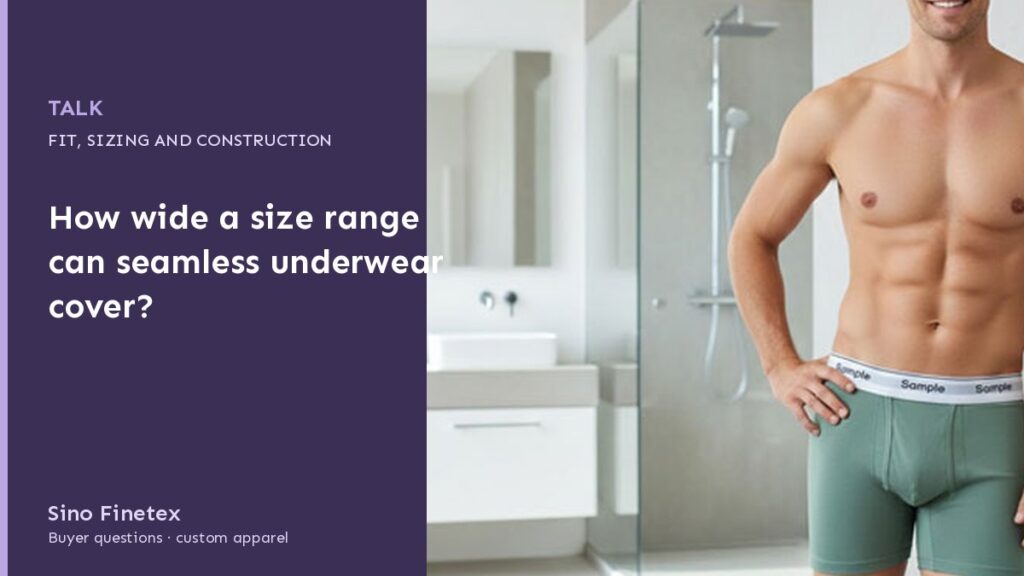
A brand wants seamless boxer briefs in only three sizes to simplify stock. The sample feels comfortable on average wearers but pinches on larger thighs and sags on slim wearers in the same size.
Main answer
Seamless knits stretch, so fewer sizes can cover more bodies than cut-and-sew garments, but each size still has a limit, so define the body range for every size, test wearers at both extremes and avoid claims such as one size fits all. A wide range works only if the knit recovers well and the garment does not become too tight or too loose.
Why seamless covers more
A seamless garment is knitted as a tube with elastane and zones of different density, so it can stretch to fit a range of body measurements. This allows fewer sizes, lower stock and simpler ranges. But stretch has limits: at the extremes the knit thins, becomes see-through and loses recovery.
Define the range per size
For each size, state the body measurements it should fit, such as waist and hip range, and the garment’s measurements relaxed and at stated stretch. Choose ranges so that neighbouring sizes overlap slightly. ASTM D2594 covers tension testing of low-power stretch knit fabrics, which is relevant to how the fabric stretches.
Test the extremes
Test each size on people at the low and high end of its range, and record comfort, marks, transparency and rolling. Check how the waistband and leg openings behave. Repeat after washing, because recovery changes. Adjust the number of sizes if the extremes do not work.
Stock and returns
Fewer sizes lower stock but can raise returns if the range is too wide. Compare the cost of an extra size with the cost of returns and discounts, using your own data after the first sales period, and adjust the range for the next order.
Labelling and claims
Show the body range for each size on the product page and label, and use clear words. Avoid claims of fitting everyone. Compare with your returns, which tell you if the range is working. For very wide ranges, add a size, since returns cost more than stock. See seamless knitting construction and seamless apparel sourcing.
Fact, recommendation, uncertainty
- Established fact
- ASTM D2594 covers tension testing of low-power stretch knit fabrics, which relates to how seamless fabric stretches.
- Recommendation
- Define the body range per size, test both extremes, and avoid one-size-fits-all claims.
- Uncertainty
- Stretch and recovery vary by yarn and machine, so each design needs its own test.
Sources and further reading
Sources checked on 24 October 2026. Standards bodies sell the full texts; we cite what their public pages state. General information, not legal or technical certification advice.
More perspectives from the team
Three further views on the same question, each by function. They add conditions and limits to the main answer; they are editorial notes, not customer reviews.
Sino Finetex Editorial Team Sourcing
Ask the knitter for the stretch and recovery data of each size and zone. Limit: data is often only available after a sample is made. Ask the knitter for the maximum stretch each zone can take before thinning.
Sino Finetex Editorial Team Product selection
Add one more size if your customers include athletic builds with larger thighs. Limit: extra sizes increase stock and minimums. Mark the body range on the label as well as the size letter.
Sino Finetex Editorial Team Quality & care
Measure the stretched size and record the thinning of the knit at maximum stretch. Limit: test on actual bodies as well as forms. Check transparency at full stretch on the lightest colour you sell.
Related products
- Men Jockstrap Manufacturer
Sino Finetex product page
- Men’s Underwear Manufacturer
Sino Finetex product page
- Bamboo Boxer Briefs Manufacturer
Sino Finetex product page
- Nylon boxer briefs
Sino Finetex product page
Related articles and topics
- TalkHow should a seamless activewear set be specified?
- TalkBriefs, boxer briefs or trunks: which should a range include?
- TalkCan I mix colours and sizes inside one MOQ on a seamless T-shirt order?
- How Does One-Size Underwear Fit Most Bodies?
- Seamless Versus Cut-and-Sew: Choosing by Product
- Fit and Stretch in Seamless Garments: Working With Four-Way Stretch
- Private-Label Underwear Fit Grading: Building a Size Run from S to 4XL
- Where to Buy Wholesale Men’s Underwear?
- How can seamless activewear better fit plus sizes?
← All questions: Fit, sizing and constructionAll Talk topics
