Illustrative situation
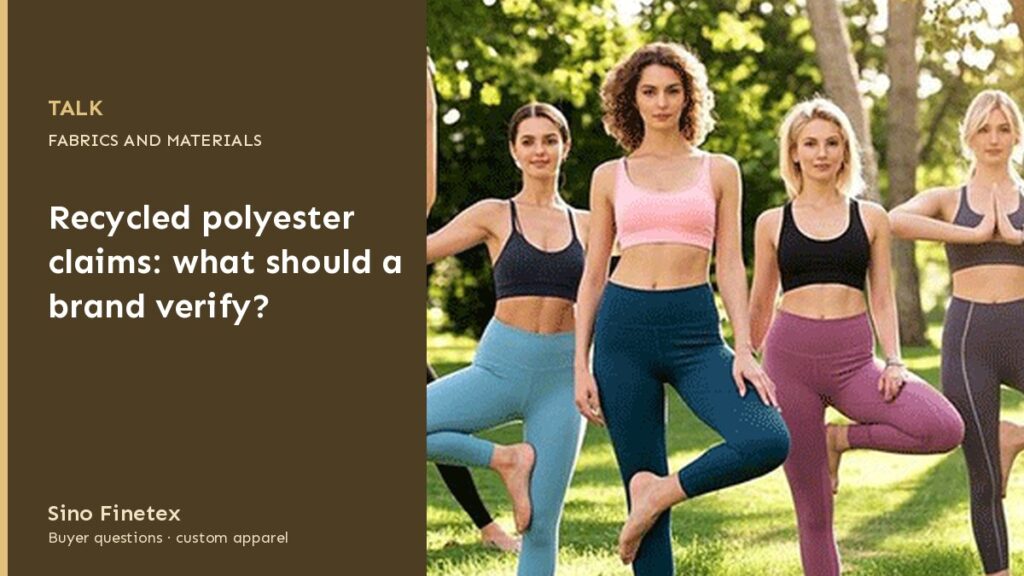
A supplier offers leggings made from "recycled polyester" at a modest premium and says the fabric is eco-friendly. The brand wants to put "made from recycled bottles" on the hang tag and needs to know what to check first.
Main answer
A recycled polyester claim needs evidence of the recycled share, the source of the material and a traceable chain of custody, so ask for certificates such as GRS or RCS with transaction documents, and check wording against the FTC Green Guides. Do not state a percentage or source, such as bottles, unless your documents show it.
What recycled can mean
Recycled polyester may come from post-consumer waste, such as bottles or textiles, or from pre-consumer waste, such as manufacturing scrap. Some products are blended with virgin fibre. Under 16 CFR 260.13, recycled content claims must be for material recovered or diverted from the waste stream, and partial claims need clear disclosure of the percentage by weight.
Certificates
Textile Exchange maintains the Recycled Claim Standard and the Global Recycled Standard. Both track recycled input through the supply chain, and GRS adds environmental and social requirements. A certificate should name the company and the products, and be valid. Ask for a transaction certificate that links your shipment to certified recycled input.
Wording on the tag
Use precise wording such as made with a stated percentage of recycled polyester, as shown in your documents. Avoid vague terms like eco-friendly unless you can support them, because the Green Guides require such claims to be substantiated. Do not describe the source as bottles unless the supplier can prove it.
Blends and partial claims
If the fabric is a blend of recycled and virgin polyester, or contains elastane, the claim should state the recycled share of the whole fabric, not just of one yarn. Ask the mill to give the percentage of the finished fabric by weight.
Checks in practice
Ask for the recycled content by weight for the exact fabric, the certificate scope and the transaction certificate. Consider testing methods that can confirm recycled content where available. Keep records for each lot. Compare costs against virgin polyester at the same quality. See sustainability and choosing a sportswear manufacturer.
Fact, recommendation, uncertainty
- Established fact
- Under 16 CFR 260.13, recycled content claims must refer to material recovered from the waste stream, with clear disclosure of partial percentages.
- Recommendation
- Obtain certificates and transaction documents, state only the share and source you can prove, and avoid vague eco words.
- Uncertainty
- Certificates show chain of custody, not environmental benefit in general or fabric performance.
Sources and further reading
- eCFR — 16 CFR 260.13, Recycled content claims (FTC Green Guides)
- Textile Exchange — Recycled Claim Standard (RCS) and Global Recycled Standard (GRS)
Sources checked on 24 October 2026. Standards bodies sell the full texts; we cite what their public pages state. General information, not legal or technical certification advice.
More perspectives from the team
Three further views on the same question, each by function. They add conditions and limits to the main answer; they are editorial notes, not customer reviews.
Sino Finetex Editorial Team Sourcing
Ask for the certificate scope and a transaction certificate for each shipment. Limit: some mills hold a certificate but supply recycled yarn only for certain orders. Ask for the recycled percentage of the finished fabric, not only of the yarn.
Sino Finetex Editorial Team Product selection
Use recycled content where your story supports it and the price is acceptable. Limit: recycled fabrics can vary in colour and handfeel. Keep claims modest and factual, since customers and platforms scrutinise green claims.
Sino Finetex Editorial Team Quality & care
Check recycled and virgin fabrics for the same strength, pilling and fastness. Limit: lab tests cannot always identify recycled origin. Keep transaction certificates with each lot so claims can be proved later.
Related products
- Compression Underwear Manufacturer
Sino Finetex product page
- Custom Sportswear Manufacturing
Sino Finetex product page
- Products
Sino Finetex product page
Related articles and topics
- TalkBamboo underwear claims: what should a buyer verify?
- TalkWhat does the FTC care labeling rule require on an apparel label?
- TalkAntimicrobial and odour-control fabric claims: what can a buyer check?
- TalkCooling fabric claims: what can actually be verified?
- How to Verify a Sustainable Underwear Manufacturer in China: GRS and Eco-Dye Guide
- How is polyester fleece made from recycled materials?
- Recycled Polyester T-Shirt Manufacturer: Sustainable Custom Apparel for Private Label Brands (June 2026)
- Sustainable Apparel Manufacturing: Why Recycled Fabrics Are the Future of the Clothing Industry
- Sustainable Underwear Manufacturer: Material Traceability and Environmental Claim Evidence
- Sustainable T-Shirt Manufacturer: Material Traceability and Environmental Claim Evidence