
Illustrative situation
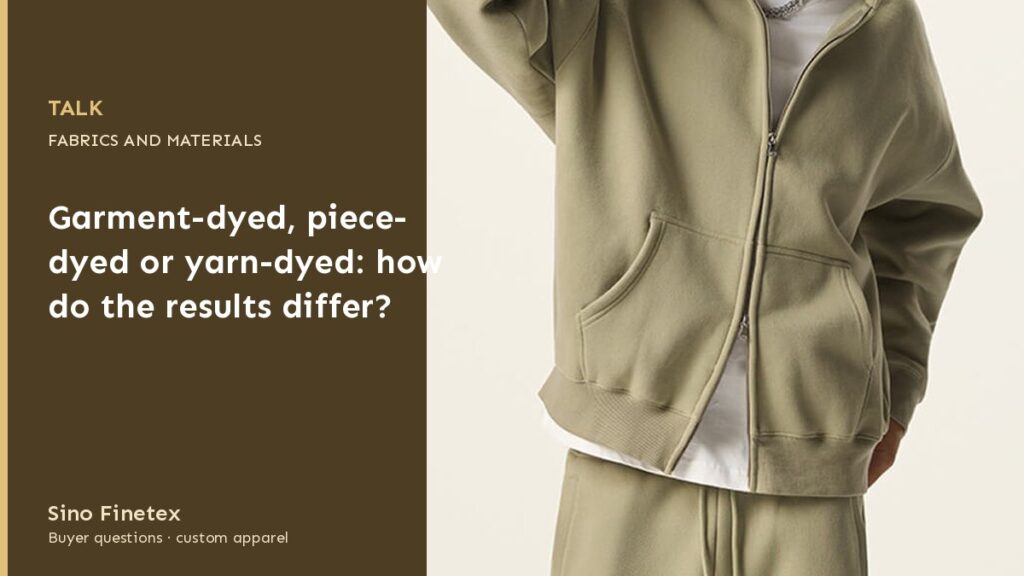
A brand wants an earthy, lived-in hoodie colour. One factory offers garment dyeing, another offers piece-dyed fabric with an enzyme wash. The garment-dyed samples look richer but differ slightly from one another.
Main answer
Garment dyeing colours the finished piece, giving a soft, lived-in look but some variation from piece to piece, piece dyeing colours the fabric before cutting and gives more consistency, and yarn dyeing colours the yarn before knitting for stripes and heathers. Choose by the look you want, the consistency you need and the cost.
Three methods
In garment dyeing, the finished, sewn garment is dyed in a machine. In piece dyeing, the fabric is dyed in the roll or in batches, then cut and sewn. In yarn dyeing, the yarn is dyed before it is knitted or woven, which allows stripes, checks and heather effects. Each stage changes the look and the risk.
Look and consistency
Garment dyeing gives a soft, slightly faded, vintage feel, since the garment is washed as it is dyed, and every piece can differ a little. Piece dyeing gives uniform solid colours and is standard for most basics. Yarn dyeing gives rich pattern options and depth, but cost and minimums are higher.
Practical issues
Garment dyeing means all components must take dye, so threads, labels and trims can show different shades, and shrinkage happens in the dye bath, so the pattern must allow for it. Small orders can suit garment dyeing, since colours can be changed late. Piece dyeing needs fabric lots and careful shade matching between rolls.
Cost and minimums
Garment dyeing can suit small runs because blank garments can be dyed to order. Yarn dyeing usually needs larger yarn lots and longer lead times. Piece dyeing sits in the middle. Ask for minimums per colour for each method before you plan your range.
What to test
Request colour fastness results, such as washing fastness under ISO 105-C06, for each method and your colour. Check shrinkage, colour variation between pieces and the match of trims. Write a shade tolerance with a limit sample. See hoodie styles and finishes and washed oversized hoodies.
Fact, recommendation, uncertainty
- Established fact
- ISO 105-C06 is a method for colour fastness to laundering, and results are reported per colour and fabric.
- Recommendation
- Use garment dyeing for soft vintage looks and small colour runs, piece dyeing for consistency, and yarn dyeing for stripes and heathers.
- Uncertainty
- Results depend on the dye house and fibre, so request samples in your own colours.
Sources and further reading
Sources checked on 24 October 2026. Standards bodies sell the full texts; we cite what their public pages state. General information, not legal or technical certification advice.
More perspectives from the team
Three further views on the same question, each by function. They add conditions and limits to the main answer; they are editorial notes, not customer reviews.
Sino Finetex Editorial Team Sourcing
Ask how many pieces per dye batch and how shade variation is controlled. Limit: tighter control may mean higher cost or larger minimums. Ask which method the factory uses in house and which it outsources.
Sino Finetex Editorial Team Product selection
Pick garment dyeing only if you accept visible variation as part of the look. Limit: customers who expect uniform colour may complain. Match the method to your restock plan, because garment dyeing makes late colour changes easier.
Sino Finetex Editorial Team Quality & care
Compare several garments from one batch side by side under daylight. Limit: write the tolerance down before production. Keep a standard sample for each batch so later batches can be checked against it.
Related products
- M8308 Vintage Washed Heavyweight Fleece Hoodie Manufacturer
Sino Finetex product page
- Hoodie Manufacturer
Sino Finetex product page
- Seamless T-Shirts & Polo Shirts Manufacturer
Sino Finetex product page
- T-Shirt Manufacturer
Sino Finetex product page
Related articles and topics
- TalkWhy does colour rub off onto other clothes, and how is it tested?
- TalkWhy does my bulk hoodie colour look different from the approved sample?
- How a T-Shirt Is Made: From Fabric to Finished Tee
- Why Does Seamless Clothing Cost More? The Hidden Engineering Behind the Premium
- How Is Seamless Garment Produced?
- Sportswear MOQ and Development Timeline
- How Seamless Knitting Technology Works and What It Changes
- Sustainable Underwear Manufacturing: How Brands Cut Waste Without Cutting Comfort